At Gartside Street Dental Lounge in Manchester city centre, our clinicians share practical guidance to help you make confident treatment decisions.
Cross-infection control became something patients thought about openly during the COVID years, and the questions have not gone away. Whenever we are asked, our honest answer is that UK private dentistry has had robust standards for decontamination for a long time — it is one of the quiet things the profession does extremely well — but it is rarely explained in plain English to patients. This post walks behind the scenes of how instruments are sterilised at a UK private dental practice, what the HTM 01-05 standard requires, and what to look for as a patient if you want to satisfy yourself before booking.
The framework that governs decontamination in UK dental practice is called HTM 01-05, full title "Decontamination in primary care dental practices." It is issued by the Department of Health and Social Care and applied through Care Quality Commission (CQC) inspection. It covers everything from hand hygiene to instrument decontamination to surgery design, water line management, and staff training. Compliance is mandatory for any registered UK dental practice. Practices are inspected against it, and reports are publicly available on the CQC website.
In plain English, the decontamination cycle has five stages: receipt of dirty instruments, washing and disinfection, ultrasonic cleaning, autoclave sterilisation, and packaging and storage. Each stage takes place in a dedicated zone with one-way flow, so used instruments never travel back through the clean route. The dirty zone and the clean zone are physically separated, often in entirely different rooms. This separation is one of the main things HTM 01-05 enforces.
Stage one is receipt. At the end of an appointment, the nurse places used instruments into a sealed transport tray and carries them to the decontamination room. They wear full PPE for this — gloves, plastic apron, surgical mask, and eye protection — because handling used instruments is the highest-risk point in the cycle. The transport tray is opened only inside the dirty zone of the decontamination room.
Stage two is washing. Modern UK practices use a thermal washer-disinfector, which is essentially a precision industrial dishwasher that runs a verified thermal disinfection cycle (typically holding water at 90 °C for one minute) alongside detergent cleaning. This not only removes blood and tissue debris but also achieves a high level of microbial reduction before the instruments ever reach the steriliser. Verification cycles are run daily, and results are logged. Manual scrubbing under running water is now a backup for items that cannot go through the washer-disinfector, not a primary method.
Stage three is ultrasonic cleaning. Instruments are placed in a tank of detergent solution that is agitated by high-frequency sound waves, which dislodge debris from joints, hinges, knurled handles, and crevices that brushes simply cannot reach. This step matters because any organic matter left on an instrument can shield bacteria from the steam in the next stage. Ultrasonic cleaners are checked daily and serviced on a documented schedule.
Stage four is the autoclave, which is where actual sterilisation takes place. UK dental autoclaves run a steam cycle at 134 °C and 2.1 bar pressure for at least three minutes (often the so-called Class B 'vacuum' cycle), which destroys all bacteria, viruses, fungi, and spores including the resistant ones. Every cycle is logged, with date, time, temperature, and pressure traces stored. Spore tests using biological indicators are run periodically to verify that the autoclave is genuinely killing what it should kill, and the results are kept for inspection.
Stage five is packaging and storage. Sterile instruments come out of the autoclave inside heat-sealed pouches with a chemical indicator strip that changes colour when sterilisation has been achieved. Each pouch is dated, and instruments are stored in a clean, segregated area. The pouches are opened only at the start of an appointment, in front of the patient. If you have ever wondered why your dentist tears open a sealed bag at the start of your visit, that is your direct evidence that the instruments have just come from the steriliser.
A meaningful proportion of dental items are not reprocessed at all. Needles are always single-use and disposed of in a sharps bin after the appointment. Endodontic files used in root canal treatment are now recommended to be single-use under UK guidance, partly to reduce any theoretical prion transmission risk. Local anaesthetic cartridges, suction tips, polishing cups and prophy heads, three-in-one tips, and many small consumables are unwrapped fresh for your appointment and disposed of as clinical waste at the end. The use of single-use items is a quiet but significant part of the HTM 01-05 framework.
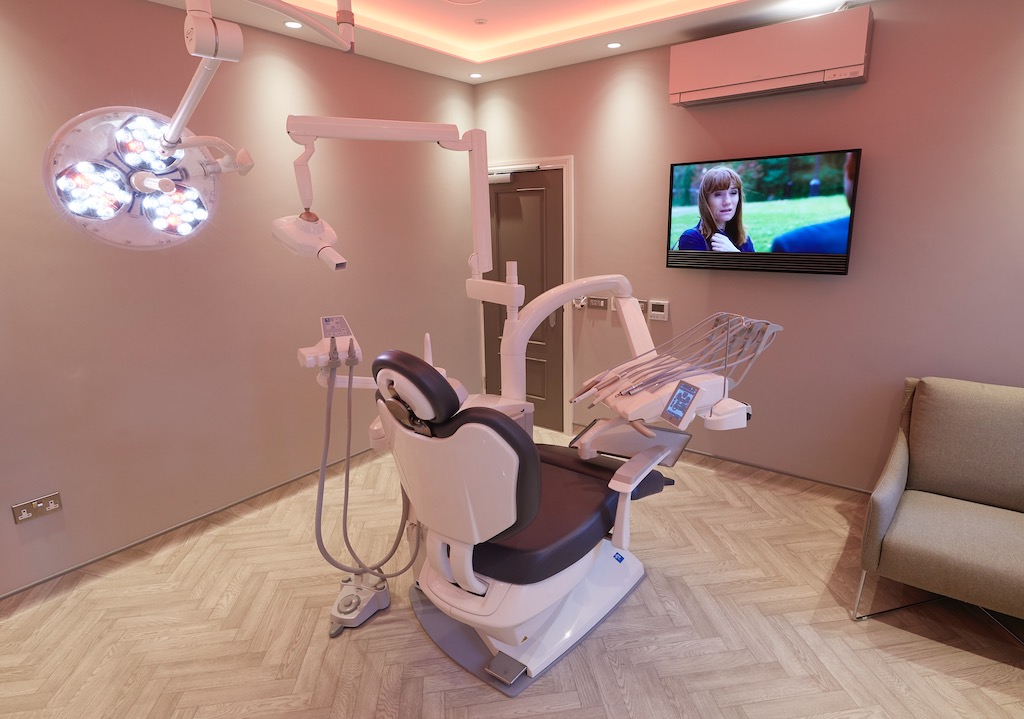
Surgery cleaning between patients is another deliberately structured process. Surfaces — chair, headrest, light handles, drawer handles, computer keyboard, tray holder — are wiped with a bactericidal and virucidal disinfectant. Headrest covers and arm rests are changed or cleaned. Dental unit waterlines are flushed. Light switches and door handles in the surgery are wiped. This is one of the main reasons appointments are not stacked back-to-back without a buffer; the turnaround takes time, and HTM 01-05 explicitly requires it to be done thoroughly rather than rushed.
Dental unit waterlines are an under-appreciated part of decontamination. The water that cools your dentist’s drill and rinses your mouth comes from a small reservoir on the dental chair, which without treatment would slowly form a biofilm of bacteria along the inside of the tubing. UK practices treat their waterlines continuously with a chlorine-based disinfectant or equivalent, flush the lines at the start of each day, and run a brief flush between patients. Water samples are tested periodically to confirm the lines remain within acceptable limits.
Hand hygiene and PPE are often overlooked in conversations about sterilisation but they are arguably the most important steps in cross-infection control. Dentists and nurses wash and gel hands between every patient, change gloves between procedures, and wear masks and eye protection for all clinical work. This was true long before COVID and it remains true now. Many of the COVID-era visible changes (visors, FFP masks for aerosol-generating procedures) were additions on top of standards that were already in place.
As a patient there are a few practical things you can look for. Sealed pouches opened in front of you. Visible PPE on dentist and nurse. A clean and organised surgery. A clinic registered with the General Dental Council (clinicians) and the Care Quality Commission (the practice as a whole). Both registrations can be checked online for free at gdc-uk.org and cqc.org.uk respectively. If you ever ask a UK practice to explain their decontamination process, a willing, calm, detailed answer is the right response; defensiveness or vagueness is a red flag.
This becomes particularly relevant when comparing UK and overseas dental care. Many of the international clinics offering low-cost cosmetic dentistry are not regulated under HTM 01-05 or CQC. Their standards may be excellent or they may not be — the variability is much higher abroad — and you have very limited recourse if cross-infection occurs after you have flown home. Part of why UK private dentistry costs more is the cost of compliance, the staff training time, the equipment depreciation, and the documentation that the regulatory framework requires. It is worth knowing what you are paying for.
If you are nervous about hygiene standards or simply curious, we are happy to walk you through our decontamination room and explain exactly how the cycle works. Cross-infection worries are sensible questions, not awkward ones, and a practice that takes the standard seriously will be glad to show its workings. Book a new-patient consultation and ask about anything you want to see. Ready to Transform Your Smile?
Take the first step towards your dream smile. Book a free consultation with our expert team at our Manchester clinic and discover how we can help you achieve the confidence you deserve.